
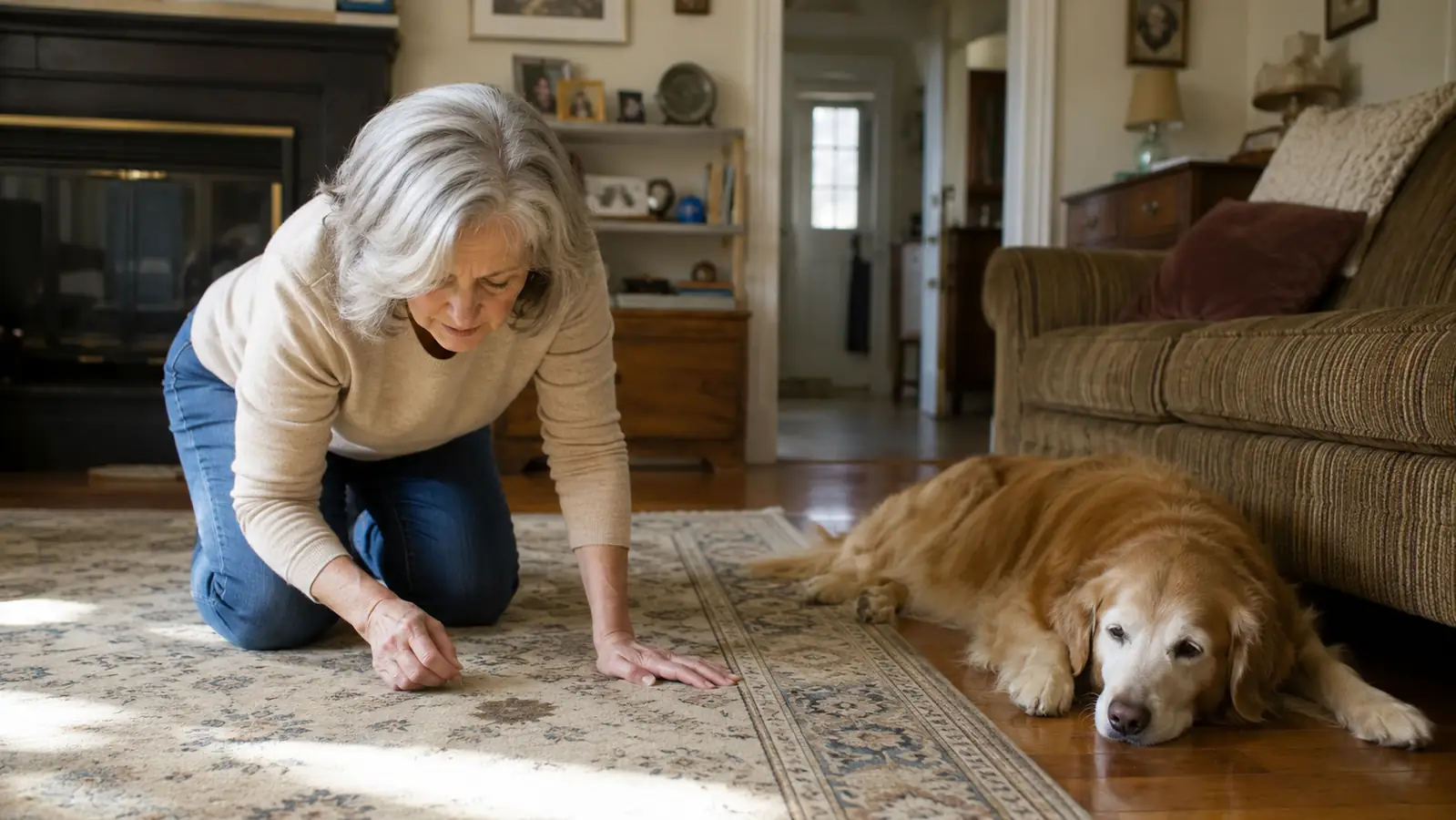
The first time I caught a whiff of it, I thought it was coming from outside somewhere. It was a warm afternoon, the heat had just kicked on, and this sour, ammonia-ish smell rolled out of my guest bedroom like it had been sitting there waiting for exactly that moment. Duke, my nine-year-old Golden Retriever, is about as reliably housetrained as a dog gets, so I knew this wasn't fresh. It turned out to be an old stain in that carpet, something that had probably happened years before Duke was even part of the family, soaked so deep into the padding that scrubbing the surface never touched it. Rocco & Roxie is what finally fixed it, but only after I sat down and learned to use an enzyme cleaner the right way, not just a quick spray and wipe, but a method that actually breaks the stain down at the source instead of covering it up. That bottle lives under my kitchen sink now, and it's the only thing that's ever made that old spot, plus a few newer ones from Patches missing the litter box edge, actually disappear instead of just smelling like flowers for a day.
If you're dealing with a stain like that, whether it's from a previous pet, an older dog like Duke who occasionally misses when his hips are stiff, or a cat who doesn't always make it all the way into the box, this guide walks through exactly how I use the Rocco & Roxie Stain and Strong Odor Eliminator to lift both the stain and the smell out for good. It takes a little more product and a little more patience than you'd expect, but none of it is complicated once you know the order to do things in.
Air freshener covers it up for an afternoon. This actually breaks it down.
Rocco & Roxie's enzyme cleaner is the bottle I reach for on every real accident in this house, old or new. It's what finally got the guest room stain to stop coming back after months of me just spraying scented carpet powder over the top of it.
Amazon Check Today's Price on Amazon →Step 1: Find every old spot before you clean anything
You can't treat what you can't find, and old urine stains have a way of drying out and fading until they're invisible in daylight even though the smell is still very real. The tool that changed everything for me was a cheap handheld UV blacklight flashlight. At night, with the room lights off, run it low across the carpet at an angle instead of straight down. Old stains that look like nothing during the day will glow a dull yellow-green under that light, sometimes in spots I never would have guessed.
As you find each one, mark it with a piece of masking tape or a sticky note right next to it. Once the room lights come back on, it is surprisingly easy to lose the exact spot, especially on patterned carpet, and you don't want to be guessing where to pour the enzyme cleaner an hour from now.
One thing I'll say plainly here. Duke and Patches are both fully housetrained and have been for years. If either of them ever suddenly started having repeated accidents somewhere new, out of nowhere, I would treat that as a reason to call the vet, not just a bigger cleaning project. Sudden housetraining regression in an older, previously reliable pet is often a sign of something medical going on, a urinary tract infection, kidney trouble, or joint pain making it harder to get outside or to the litter box in time. Cleaning up after it is the right move either way, but it isn't a substitute for a vet visit if the accidents are new and repeating.
Step 2: Saturate the stain, don't just wipe the surface
This is the step most people skip, and it's the whole reason light surface cleaning never fully works on old stains. What you can see and smell on top of the carpet is only a fraction of what soaked down into the backing and the padding underneath when the accident actually happened, sometimes months or years earlier. A light misting across the top might make a spot smell better for an afternoon, but it does nothing for the source, because the real odor is living down in the pad, not in the fibers you can reach with a paper towel.
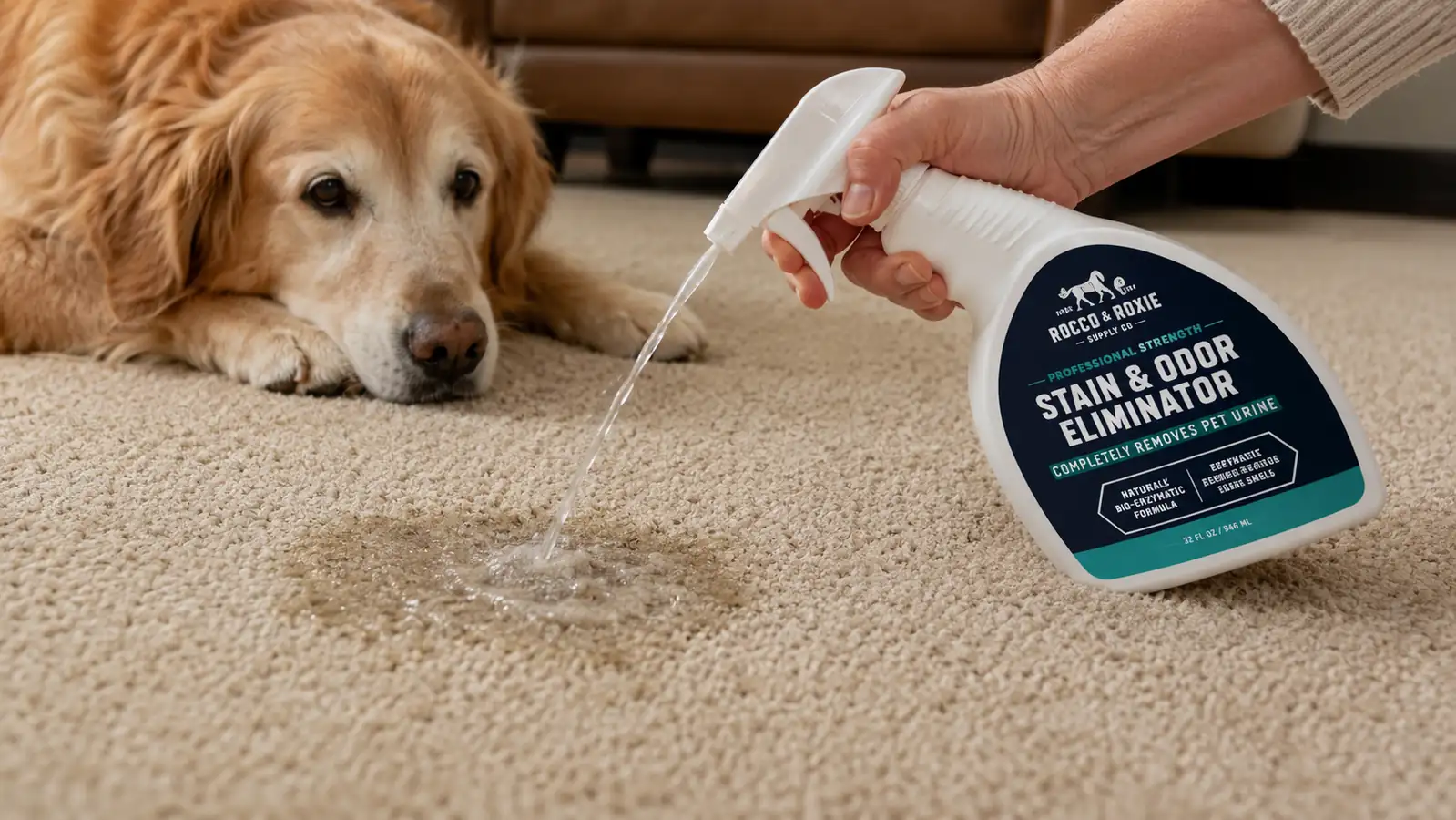
So pour the Rocco & Roxie generously, not a spritz or two. I cover the whole stain plus about an inch of margin around the edges, using enough liquid that I can feel it's actually reached the backing when I press down gently with a gloved hand, not just wetted the top of the fibers. For anything that's been there a long time, I'd rather use more product once than a little product three separate times.
The 32-ounce Rocco & Roxie bottle sounds like a lot until you're actually pouring it on old stains the right way. If you found more than one or two spots on your blacklight walk-through, do the math before you start so you're not caught halfway through a treatment with an empty bottle. I keep a second one in the closet now, because there is nothing more frustrating than saturating a stain, walking away, and realizing you don't have enough left to finish the last one properly.
Step 3: Let it sit and resist the urge to wipe it up right away
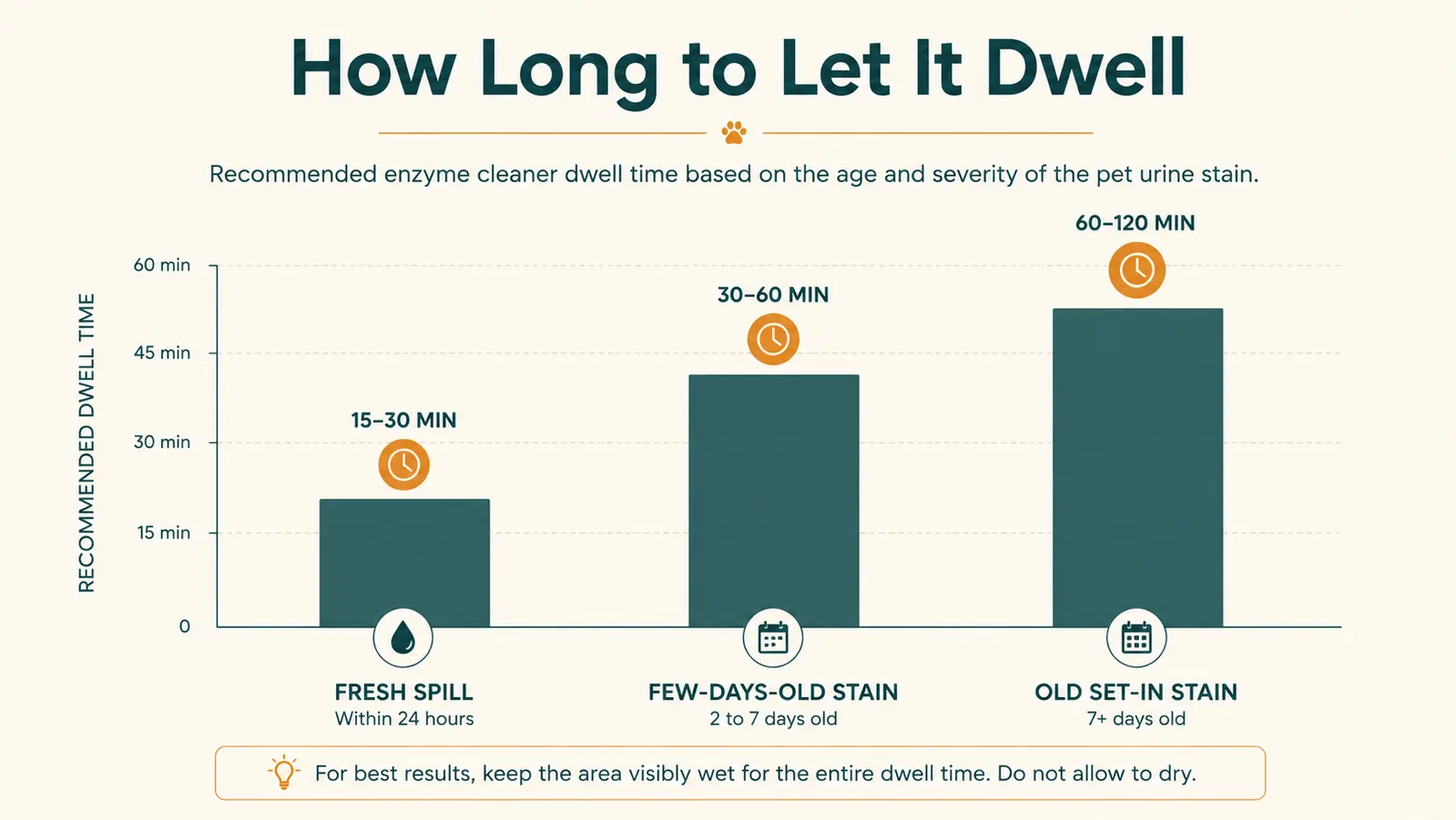
This part takes patience, and it's the step I get impatient with more than any other. Enzyme cleaners work because they contain live bacteria that actually consume the uric acid crystals causing the smell. That process takes time. Wiping it up two minutes after spraying basically cancels the whole thing before it has a chance to start.
I follow the bottle's guidance as a starting point, usually letting a fresh spot sit at least ten to fifteen minutes, but for something old and deeply set, I let it dwell much longer than that. Sometimes I'll cover the spot with a damp towel or an upside-down mixing bowl so it doesn't dry out before the enzymes finish working, and if the pets and grandkids aren't going to be underfoot, I'll leave it a few hours or even overnight.
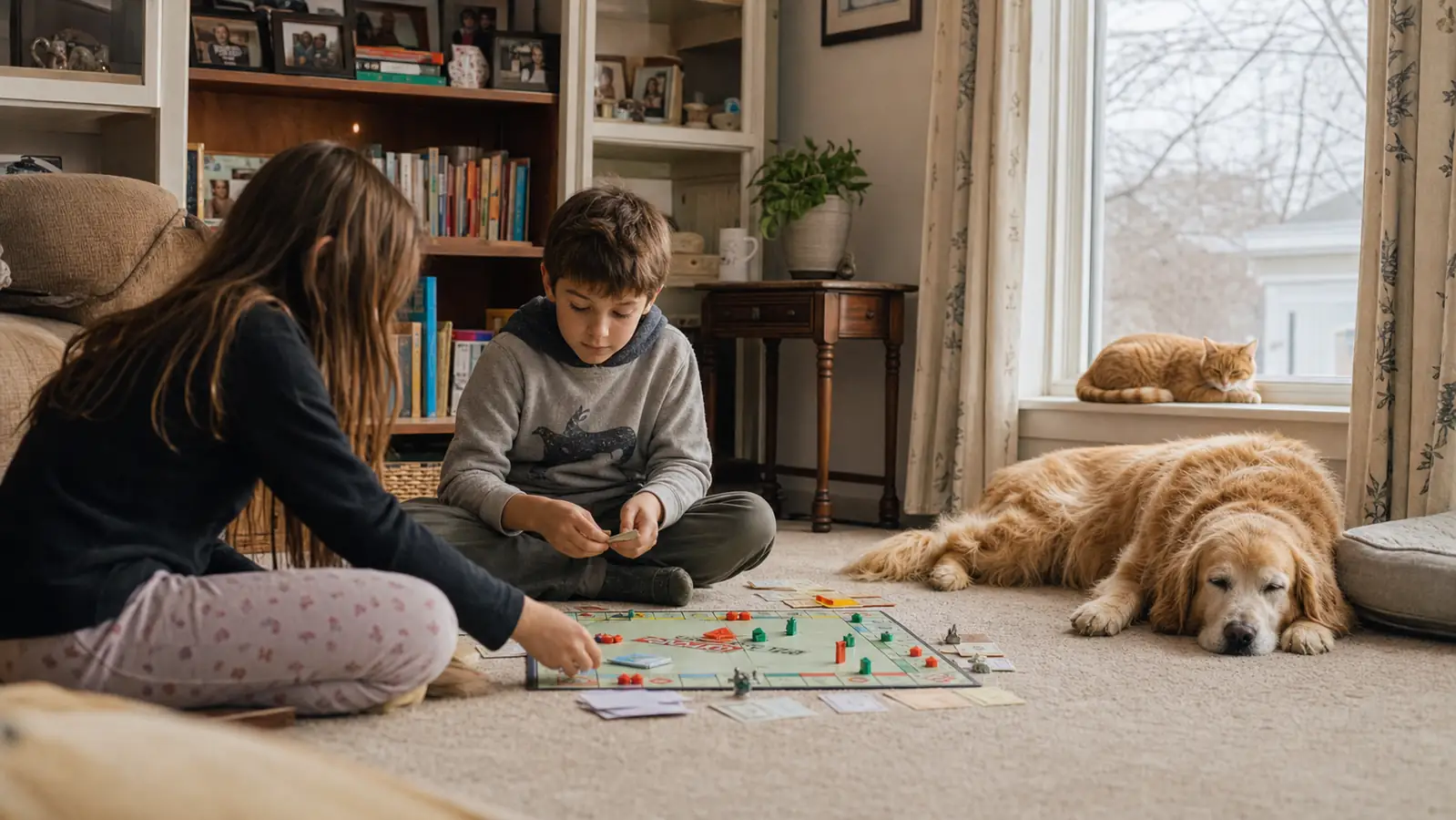
While it's wet, keep everyone off it. I block the doorway with a laundry basket or a chair if I have to, keep Duke and Patches out of the room, and if the grandkids are visiting that weekend, I let them know not to walk through it. A little bit of setup here saves you from having to start the whole process over.
Don't panic if the smell seems a touch stronger while it's actively working before it fades. That's the enzymes breaking the compounds apart, not the cleaner failing. It settles down as it finishes and as the spot dries, and that's usually a better sign than a spot that smells like nothing at all right away, which sometimes just means you didn't saturate deep enough to reach the source.
Step 4: Don't mix it with anything else
This one trips up a lot of people, myself included the first time around. Vinegar, ammonia-based glass cleaner, bleach, or a store-bought carpet shampoo layered on top of or underneath an enzyme cleaner will kill the live bacteria before they finish the job. The spot looks treated, the room smells like cleaner for a day, and then the odor comes right back within a day or two because the actual source was never fully broken down.
I wait until the Rocco & Roxie has fully dried, usually about 24 hours, before I use a steam cleaner or any other product on that same spot. And I never pre-treat an old stain with vinegar the night before thinking it'll help the enzyme cleaner along. It doesn't. It just gives the bacteria a harder job to do once you finally get to it.
Step 5: Blot, dry completely, and check again
Once the dwell time is up, blot the spot with clean white towels, pressing down to lift the moisture out rather than rubbing or grinding it into the fibers. Rubbing pushes whatever's left deeper into the pad instead of pulling it out.
Let it air dry completely before you decide whether it worked. I run a box fan on it or open a window for a few hours, because damp carpet holds onto smell even after the enzymes have finished their job, and judging it while it's still wet will make you think you failed when you didn't.
Once it's fully dry, run the blacklight over it again. Old, deeply set stains sometimes need a second full treatment from start to finish, and that's normal. It doesn't mean the Rocco & Roxie failed, it means the stain had more built up in the padding than one round could fully reach.
What Else Helps
A little routine maintenance keeps this from becoming a project you have to repeat constantly. I scoop Patches's litter box daily and give it a full wash weekly, because a dirty box is the number one reason a cat starts looking for somewhere else to go. I also wipe down the edges of the box itself, since litter dust and residue build up their own smell over time that has nothing to do with an accident. And every few months, especially before the grandkids come for the weekend, I do a quick blacklight walk-through of the main rooms just to catch anything before it has time to set in.
The Rocco & Roxie works on more than carpet. I've used it on the couch cushion Duke used to nap on before we got his orthopedic bed, on the throw rug by Patches's litter box, and even on a hardwood spot near the back door once, though on hardwood I saturate a lot less and dry it a lot faster since standing liquid isn't good for wood or the subfloor underneath it. On fabric or upholstery, I always test a hidden corner first, just to be sure the color holds before I saturate the whole cushion.
Here's the thing nobody tells you when you're first dealing with this. If Duke or Patches keeps going back to sniff, scratch at, or hover near a spot you already cleaned, that is telling you the odor is still there, even if you can't smell it and even if it doesn't glow under the blacklight anymore. Their noses are far more sensitive than ours. That behavior is an odor problem, not a stain problem, and definitely not a training problem. The fix is another full, saturating round of enzyme cleaner on that exact spot, not a scolding and not assuming they're being difficult on purpose.
If your dog or cat keeps going back to the same spot on the carpet, that's not a stain anymore. That's an odor they can smell and you can't, and the fix is another round of enzyme cleaner, not a scolding.
Old stains need a real enzyme cleaner, not another can of carpet powder
This is the bottle I keep on hand for Duke's occasional stiff-morning miss and for Patches's litter box edges, and it's what finally got that old guest room stain to actually stop coming back.
Amazon Check Today's Price on Amazon →